

Topic: Growth and innovation
Former NSW Government Minister Victor Dominello spoke at the Telstra InfraCo Business Connect about how real productivity gains happen with digital connectivity.
The AI market is currently dominated by the race for capacity and compute. A vast amount of capital is being deployed to claim capacity now, on the calculation that the cost of falling behind outweighs the cost of overcommitting. Here we explore how connectivity infrastructure is evolving in tandem to enable the success of this new ecosystem.
6 minute read
In 2026, investment in global spending on Artificial Intelligence (AI) is estimated to reach US$2.5 trillion1Refer to sources at end of content. That’s larger than the annual economic output of Australia, the world's twelfth-largest economy2Refer to sources at end of content. With AI now a macro-economic force in its own right, it is creating a diverse, distributed ecosystem of providers, partners and customers.
Organisations in the AI ecosystem are racing to win market share. Their choices of digital infrastructure will shape their ability to compete now and into the future.
– Roary Stasko, Chief Customer & Growth Officer, Telstra Digital Infrastructure
The four largest hyperscalers have planned over US$700 billion in capex in 20263Refer to sources at end of content. Morgan Stanley Research4Refer to sources at end of content estimates global data centre construction costs alone will reach US$2.9 trillion in 2028.
As demand grows, the market structure is changing. Hyperscalers consume their own capacity for their models, as well as selling it on. Frontier AI model labs like OpenAI and Anthropic seek compute capacity to serve mass user adoption. And so the neocloud segment has become a growing player in compute (GPU) capacity. For neocloud providers, competing on availability, speed and cost means securing, deploying and scaling infrastructure ahead of demand is critical. And doing so requires answering three central infrastructure questions:
In any major AI deployment, land, power and compute resources come first. Connectivity must be ready when those upstream pieces land. And it must enable speed to market, flexibility, and efficient scalability. With that in mind, connectivity that supports growth in this market will need to have the following characteristics.
In the current capacity race, requirements evolve rapidly as site selection and data centre build progress in parallel. Feasibility, commercials, and network design can land within a matter of weeks.
The ability to align network delivery timelines with data centre build and GPU deployment schedules is vital. Responding at short notice, with limited lead time between site confirmation and service activation, is now the operating norm. Backbone connectivity infrastructure already in the ground, in key corridors, with capacity ready to go, and rapid deployment capability helps maintain pace and avoid lost market opportunities.
The days of slow, incremental increases over a multi-year timeframe have gone. Deployments are increasingly at the higher end of the spectrum, with AI workloads pushing requirements toward multi-terabit capacity upgrades. Over the past two years, demand for 400G connectivity on our network has grown by an estimated 80% per annum, on average.
Growth trajectories in this part of the market are often non-linear as well. A single-facility entry can become a multi-site, multi-city operation within months.
The huge demand can make planning a network complex. Infrastructure needs to be built-ahead and provisioned to meet immediate needs and expanded as needed, without multiple redesigns or rebuilds as requirements evolve.
While deploying new links can take time, having a range of technology options on existing core networks offers the flexibility to support different approaches. If operating the network isn’t the main business focus, managed lit services offer dedicated-fibre performance without the hassle of ongoing management. At the other end of the spectrum, dark fibre is an option if there’s a desire for more control.
Having access to these options, along with a product runway to match growth, can help expansion faster and more efficient.
Commercial flexibility is equally important. Models that allow capacity to be scaled into over time, rather than committed to fully upfront, can help make initial deployment faster and align cost to the pace of growth.
As AI services become always-on and autonomous, network resilience moves from technical preference to commercial requirement.
Quad-path diversity in metro areas, with dual or tri-path diversity on intercity routes, is increasingly standard for hyperscale deployments. As the broader market matures, we expect those diversity requirements to extend across the sector.
Genuine route diversity means fibre following physically separate paths, not different providers sharing the same duct. In Australia, where intercity distances make independent corridors scarce, proven diversity is highly valuable.
Global network teams are focused on strategic decisions. That makes local infrastructure expertise something the connectivity partner can bring to the relationship, effectively extending in-house capability.
When network teams are lean and stretched across regions or the globe, a local partner who knows the broader infrastructure ecosystem, data centre providers, site selection options, deployment pathways, becomes a useful extension of the team.
In a market like Australia, where the physical infrastructure landscape is specific and the deployment timelines are compressed, a partner with ground-level knowledge of corridors, routes, and constraints effectively extends the provider's own planning capability.
Practical on-the-ground support, installation, remote hands, and fault response, can help speed up deployment without requiring an in-country workforce build-out. Collaboration with partners who have that deep in-country expertise can also help empower and upskill neocloud global teams. The operational burden of managing parallel workstreams, navigating complexity, and adapting decisions as priorities shift becomes shared rather than carried alone.
Australia's role in regional AI infrastructure is significant. A stable investment environment, land availability, renewable energy potential, and its role as a sovereign data transit hub for the Asia Pacific region make Australia a natural and valuable expansion market. New subsea cable investments are reinforcing that position, enhancing Australia’s connections to Southeast Asia, the Pacific and North America.
Hyperscaler commitments in Australia are already substantial: Microsoft's $25 billion through 2029, AWS's $20 billion from 2025 to 2029, Google's possible $20 billion5Refer to sources at end of content. We are also seeing neocloud and AI-native activity accelerate alongside, with more new entrants expected over the next 12 months.
The demand for power and land in established data centre precincts in Australia is also reshaping the infrastructure map. AI factories are planned for regional areas where energy is cheaper, more abundant, and increasingly renewable, with Tasmania, parts of Queensland, and regional New South Wales all attracting interest. State governments are helping to accelerate this investment. In New South Wales for example, the Investment Delivery Authority aims to support 15 data centre projects valued at $51.9bn6Refer to sources at end of content. The distribution of AI compute can help increase available capacity, but it also amplifies the connectivity requirements.
At the same time, increasing demand for international connectivity is placing pressure on subsea capacity across key APAC routes. As demand expands into APAC, network design increasingly needs to account for cross-border data flows from day one.
No one can predict exactly the business models that will come to dominate the AI-era, but demand is going to continue in one direction, with AI compute and inference as on-demand services, consumed at scale, with infrastructure largely invisible to the end user.
Getting there is likely to see multi-site, distributed architectures. Over the next two to three years, we expect growing demand for dedicated high-capacity paths between an increasing number of sites. Demand will intensify on regional routes, inter-capital connectivity, and cross-border links as providers expand across APAC.
Establishing strong connectivity foundations now, with the right combination of speed, capacity, diversity, and local expertise, creates the position from which to enable growth as the new AI ecosystem evolves.
In the AI ecosystem, infrastructure is either the foundation for growth, or a cap on it. We’re making infrastructure the former by giving customers the capacity and agility to scale on our Aura Network.
– Roary Stasko, Chief Customer & Growth Officer, Telstra Digital Infrastructure
Telstra has invested in the Aura Network, Australia's newest large-scale intercity fibre network, to meet the demands of this evolving ecosystem. Aura Network uses Ciena’s advanced optical innovations to offer up to 6.3x increase in terabits per second compared to a typical existing fibre network, demonstrating the value of high-performance throughput for AI model training or updates.
This network also connects the principal AI hubs, and data centre to data centre directly through custom-built routes. And our initial routes reach ~95% of national data centre demand, and connect 16 subsea cable landing stations the Aura network is designed to support evolving AI and digital infrastructure requirements.
Flexibility comes from a product range designed to match what each provider needs today, with the scalability to meet them where they need to go. Aura Wavelength delivers high-capacity, low-latency, point-to-point connectivity for providers who need reliable, scalable lit bandwidth between sites. Aura Direct Spectrum lets providers customise and scale their own spectrum, choose their equipment, and take control of their network. And Aura Dark Fibre gives full control and flexibility over a dedicated part of the same network that underpins the network
The Aura Network extends from terrestrial fibre with key international subsea cable systems. We recently increased our strategic subsea capacity by securing access to Google-supported Pacific and Australia Connect cable systems7Refer to sources at end of content. This will enable us to deliver diverse and secure subsea pathways and ensure the nation’s networks are equipped to handle the growing demands of AI applications and workloads.
For anyone entering or expanding in Australia and the APAC region, the combination of pre-built national reach, route diversity, scalable capacity, and local planning expertise addresses the specific connectivity needs of this market.
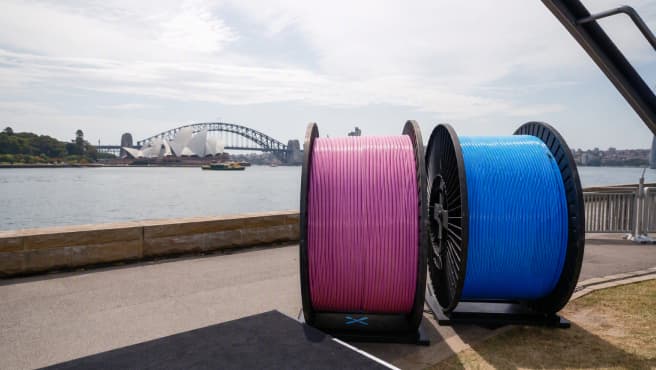
Connectivity infrastructure is a critical enabler of the new AI ecosystem, where seizing market opportunities depends on how quickly providers can establish and scale their presence. At Telstra Digital Infrastructure, we are evolving our networks and services to support every part of this ecosystem with capacity, speed and agility.
To learn more about the Aura Network and our products, visit our website.


